100 Bad Paintings
 Kerri Dixon
100 “bad” paintings can transform your skills. Learn how to plan a theme, reduce overwhelm, and build confidence through repetition.
Why Repetition Builds Skill (And How to Plan It So You Actually Do It)
You may have heard the concept of making 100 bad paintings.
And before you panic — no, this isn’t about lowering your standards.
It’s about taking the pressure off trying to create a masterpiece every single time you sit down to make art.
So when we say “100 bad paintings,” we’re really saying:
Not 100 perfect paintings.
Not 100 masterpieces.
Just 100 paintings you work through to build skill through repetition.
And no — we’re not putting a time limit on it either (unless you personally thrive on that kind of structure).
Somewhere Out There Is Your 100th Painting
Think of it like this:
Somewhere out there is your 100th painting — the one where everything clicks.
It’s the one where:
-
your values finally feel natural
-
the fur looks soft and believable
-
you’re not intimidated to start
-
you trust your process
You sit back and think, “Yep… I get it now.”
But you don’t get to painting number 100 without painting number 1.
And number 2.
And number 37.
And number 82.
That’s the whole point.
It’s not about racing to 100.
It’s about what happens to your skills while you get there.
The Ceramics Teacher Story From Art & Fear
There’s a story in the book Art & Fear that explains this perfectly.
A ceramics teacher divided a class into two groups:
-
Group 1 was graded on quantity. Their final mark would be based on the amount of pots they produced.
-
Group 2 was graded on quality. They only needed to create one pot — but it had to be perfect.
At the end of the term, something surprising happened:
The highest quality pots came from the quantity group.
Why?
Because while the “quality” group spent their time theorising and trying to design perfection…
the “quantity” group was just making.
They were testing. Adjusting. Learning. Repeating.
And through repetition, they improved — and they accidentally made better work.
The lesson isn’t “make bad art.”
The lesson is:
Mastery comes from doing.
69a635673d7af_lg.png)
Why This Can Feel Harder When You’re Older
If you’re over 50 and coming back to art, perfectionism often hits harder.
Not because you care more… but because you’re used to being capable.
You’ve built a life. You’ve had careers. You’ve managed responsibility.
You’re not used to feeling like a beginner again.
A 20-year-old expects to be messy while they learn.
A 55-year-old expects to be competent.
So when your hand isn’t matching your expectations, it feels uncomfortable.
And that gap between identity and skill creates pressure.
Pressure slows growth.
On top of that, your eye often develops faster than your hand.
You can see what’s wrong before you can fix it.
That’s not lack of talent — it’s that your standards are high.
You just need mileage to match what your eye can already see.
That’s exactly where the 100 paintings idea helps.
Don’t Just Paint 100 Random Things — Plan First
If the thought of 100 paintings makes you want to lie down dramatically on the floor… fair.
So here’s the key:
Planned repetition is easier.
If you’re going to commit to 100 paintings, start by choosing a theme — and make sure it’s one you actually love, so you won’t get bored halfway through.
Your theme can be very specific:
-
100 animal heads
-
100 cow portraits
-
100 eyes
But I’d also encourage you to think slightly broader if your goal is improving overall skill.
For example, “100 eyes” will make you brilliant at eyes… but it won’t do much for feathers, bark, fur textures, backgrounds, or composition.
So you could choose a looser theme like:
-
Around the farm
-
Birds in your backyard
-
Native wildlife
-
Farm animals
-
Textures and details in nature
What I Would Do (Farm Theme Example)
If I was starting this properly, I’d begin by going out and taking photos around my farm.
I’d build a bank of reference images first:
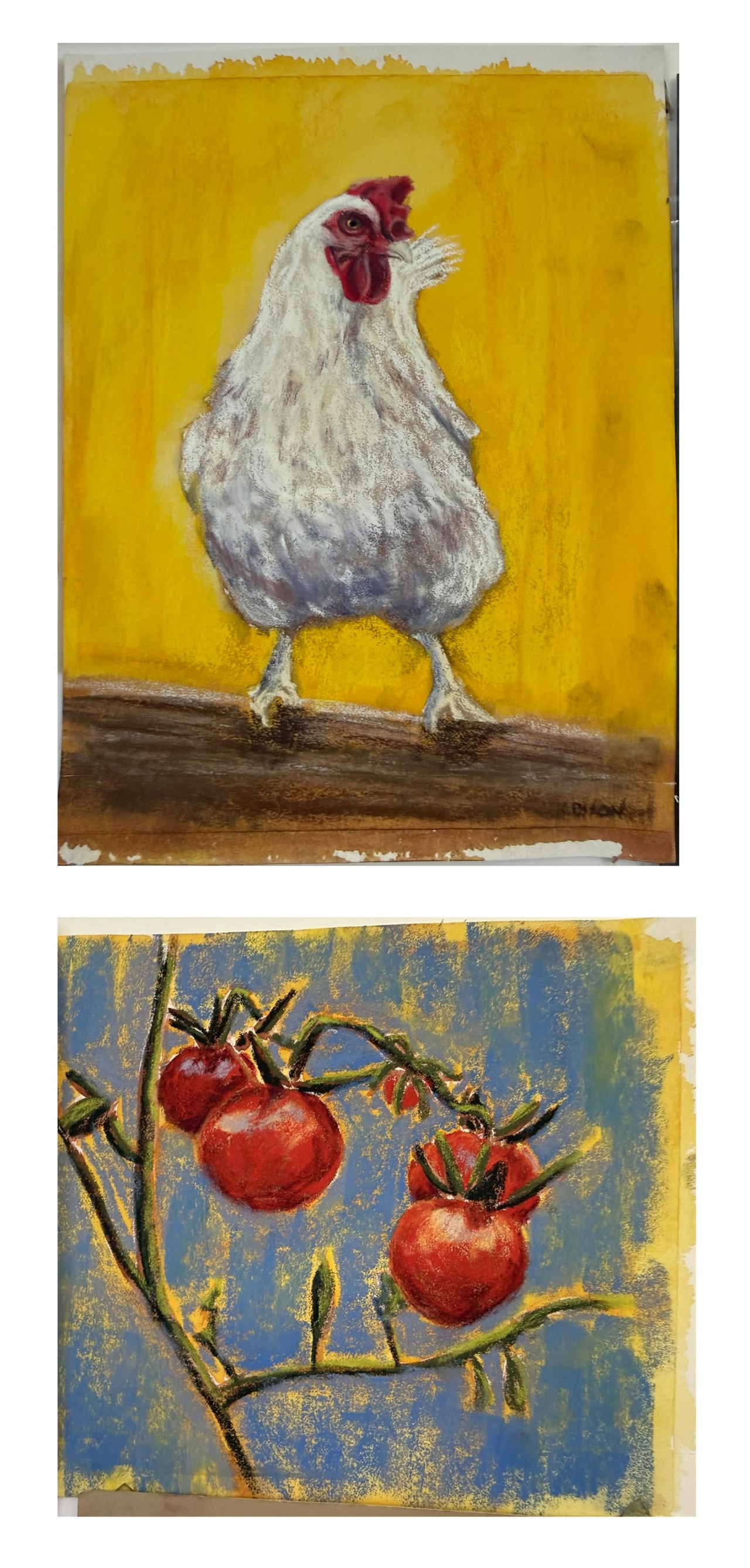
-
cows
-
chickens
-
old timber posts
-
rusty chains
-
leaves casting shadows on fence posts
-
little wild tomatoes growing
-
textures everywhere
Because the last thing you want is to sit down with blank paper and think:
“What am I going to paint?”
You want to sit down and choose from options you’ve already prepared.
That’s how you reduce overwhelm.
Remove Roadblocks Before You Start
Prior planning isn’t just about the theme — it’s about making the whole thing easy to follow through on.
Before you start, make sure:
-
your paper/canvases are ready to go
-
the size is chosen (keep it small!)
-
your materials are within reach
-
your reference images are sorted into a folder
You want to remove every excuse your brain is going to throw at you like:
-
“I don’t have the right size paper”
-
“I’ll start once I buy more supplies”
-
“I’ll do it when I feel ready”
Make it easy to show up.
That’s what planning does.
Break the 100 Into Smaller Blocks
A hundred sounds huge…
Until you break it down.
For example:
-
10 animal eyes
-
10 fur studies
-
10 feather studies
-
10 value-only studies (no colour)
-
10 charcoal studies
-
10 limited palette pieces
-
10 composition experiments
-
10 small full animals
-
10 backgrounds
-
10 “push the style” pieces
Suddenly it’s not “100.”
It’s just “10… ten times.”
No Time Limit (Unless It Helps You)
I’m not setting a time limit on this, because I know myself.
“100 paintings in 100 days” feels like pressure, and pressure defeats the purpose.
This is skill-building. Not a race.
It might take you a year. It might take three.
That’s fine.
But if you work better with a time challenge, go for it.
Some people thrive with structure. Some thrive with flexibility.
Either way, the win is in the doing.
Even 15 minutes a day counts.
Studies vs Portfolio Pieces
This part is important:
Not every painting is meant to perform.
Some paintings teach you.
Some paintings you frame.
A study is:
-
skill focused
-
experimental
-
messy
-
informative
A portfolio piece is:
-
refined
-
intentional
-
designed for display
Professionals absolutely separate these.
They build final pieces on a mountain of studies.
We don’t see the mountain — we only see the masterpiece — and then we expect ourselves to skip the learning stage.
That’s not realistic.
Label your studies as studies.
You’ll feel the weight lift immediately.

A Fun Layer: The Color Cube Challenge
Now here’s a really fun idea to add to this.
I have a tool called the Color Cube by Sarah Renae Clark — it’s a box of curated colour palette cards.
And I thought:
What if every time I start a new painting… I pull a card?
Instead of defaulting to safe, realistic wildlife colours — browns, greys, natural tones — I let the palette guide me.
This does a few powerful things:
-
removes decision fatigue
-
forces you out of “safe” colour habits
-
makes you focus on values (because values matter more than colour names)
-
encourages mood exploration
-
breaks photo dependency
And it can seriously help you develop your style, because you’ll start noticing which palettes you naturally gravitate toward.
No Color Cube? Make a Swatch Jar
Go to a paint shop or hardware store and grab a handful of paint swatches.
Throw them in a box.
Pick one before each painting and work inside that palette.
Keep your eye on values first — even turn your reference photo black and white if you need to.
Why This Works (And Why I Believe In It)
I’ve noticed in my own work over the past few years — especially since teaching inside The Creative Barn and creating a new tutorial every month — my skills have improved dramatically.
Repetition builds skill.
And I see it constantly with members too — the ones who keep showing up are the ones who grow fastest.
The biggest mindset shift is this:
Stop treating every sheet of paper like it has to prove something.
It doesn’t need to justify the cost of the materials.
It doesn’t need to confirm you’re “good enough.”
It’s not a test.
It’s a stepping stone.
You are not wasting paper.
You are investing in skill.
Your 100th Painting Is Waiting
So keep this in mind:
Somewhere out there is your hundredth painting — the one where it all clicks.
But it’s built on the imperfect, slightly awkward paintings that come before it.
You’re not behind.
You’re already at a number.
So keep increasing it.
Create consistently.